
Healthy calves: building systems that work
Progress over perfection. Simple done well.
Introduction – a new year, a new system
Tommy Heffernan Veterinary consultant
Firstly, Happy New Year to everyone out there and good luck in the season ahead.
In this article, I’m going to look at the essentials of calf rearing — what I’ve learned as someone who specialises in this area and has a real passion for calf health. I’m also very lucky in my role with Precision Microbes to visit a wide range of farms: happy customers, different systems, different approaches, all rearing calves in their own way and often getting good results.
I want to start by setting the tone early. This is about progress, not perfection. Making small changes over time can have a real impact. I’m yet to visit a perfect farm, and I’m yet to meet a perfect human.
And on that note — like many imperfect humans — I’m starting the new year again with health goals. I made progress in 2025, but 2026 is a new me. How many of us are saying that?
It’s interesting when we think about health, weight loss, or any outcome at all — including healthy calves. We often focus on the outcome, but it’s actually the behaviours, processes, and systems that drive results. Calves, in particular, love attention to detail and consistency.
So in this article, I want to look at both the why and the how of calf rearing — the habits, systems, and decisions that drive the outcomes we want. Let’s lock in and look at what really matters for calf health in 2026, and what needs to be thought about before a calf even hits the ground.
What are we actually trying to achieve?
When we talk about calf rearing, we do need to define what we mean by success.
Healthy calves are calves that:
- double their birth weight by weaning (or more),
- have low levels of disease,
- require minimal antibiotic intervention,
- and make it through the rearing period without unnecessary losses.
Mortality matters. Morbidity matters. Antibiotic use matters. But ultimately, what we’re trying to produce is a strong, resilient calf.
That’s critically important for dairy heifers — they’re the future of the herd — but it’s just as important for beef calves, whether they’re being reared on farm or sold on. We’re producing an animal, and quality matters.
Every system is different. Breeds differ. A small crossbred calf is not the same as a large Holstein Friesian calf. British Friesians, late-season calves with beef influence — all bring slightly different challenges. But the principles that underpin good calf health are remarkably consistent.
Disease costs money, of course. Pneumonia and scour are expensive. But in my experience, the most precious resource disease steals is time. Nobody wants sick calves. They’re frustrating, stressful, and disruptive during an already busy period.
To me, there are two key stages when assessing calf success. The first is midway through the milk-feeding period — are calves healthy and relatively disease-free? The second is at weaning and post-weaning — because calf rearing is a long game, not a two-week project.
We’ve made huge progress in this space. Infrastructure has improved. Knowledge has improved. Vets, farmers, and advisors have driven real change. The advice is out there. But where I think we still need to reflect is on where calf rearing trends are going, and how systems are holding up under pressure.
Calf rearing as a system
When we think about calf rearing properly, it’s never just one thing.
Even something like Precision Microbes — a unique probiotic and postbiotic liquid that I’m very passionate about as a tool — is only one part of the overall system. What really drives results are management decisions and daily routines.
Calf health is multifactorial, and that can be frustrating. It’s a bit like someone telling you to lose weight by simply “moving more and eating less”. It’s true — but anyone who’s tried it knows how hard it is when the cake arrives with the tea at ten o’clock at night.
So let’s simplify it.
There are three core parts to every calf-rearing system:
- The calf
This is the biology of the calf.
What does it need around colostrum?
How do we build immunity?
How does stress affect it?
What does a healthy calf actually look like when we walk through the shed in the morning?
- The environment
This is where calves are reared — from the calving pen to individual pens to group housing. Weather, housing, hygiene, airflow, and space all have a massive influence. In seasonal systems, we can’t control the weather, but we can control how we respond to it.
- The people
Often forgotten, but absolutely critical. The farmer, the calf rearer, the team. Calves love attention to detail and consistency. Systems only work if people can deliver them every day.
Where systems break down, disease follows. I’ve seen farms with identical infrastructure and genetics get completely different outcomes purely because of how systems are run. I’ve also seen excellent calves reared in basic sheds, and poor calves in state-of-the-art facilities.
Routine beats buildings.
Calves will always tell us how our system is working.
The seesaw principle: immunity versus infection pressure
As a young vet student, I spent a lot of time learning about the complexity of disease. And disease is complex.
But over time, I’ve come back to a simple idea:
make the complex simple, and make the simple compelling.
When it comes to infectious disease in calves, there’s one principle that explains most of what we see on farms. I call it the seesaw principle.
On one side of the seesaw, we have immunity. Everything we do to support immunity pushes that side up — colostrum, nutrition, gut health, stress reduction.
On the other side, we have infection pressure — hygiene, stocking density, mixing ages, weather, and the overall burden of bugs in the environment.
Disease happens when the seesaw tips.
Even with good immunity, seasonal systems can reach a point where infection pressure becomes so high that disease is almost inevitable. That doesn’t mean everything is being done wrong — it means pressure has built.
Every pillar of calf rearing influences one side of this seesaw or the other. Gut health supports immunity. Hygiene pulls infection pressure down. Cold stress pushes immunity down. Damp conditions push infection pressure up.
As I write this ahead of spring, it’s cold. Cold calves burn energy to stay warm. Immunity suffers. Disease follows.
So whenever we think about calf health, we should always come back to the same question:
Which side of the seesaw is tipping — and what can we realistically influence right now?
The pillars of healthy calves
Once we understand calf rearing as a system — and once we understand the seesaw between immunity and infection pressure — we can start to break things down into the key pillars that consistently drive good outcomes.
These pillars don’t work in isolation. They stack together. When they’re delivered well, calves cope better, systems flow better, and the busy calving season becomes more manageable.
Pillar 1 – The cow and heifer: setting the calf up before it ever hits the ground
If we strip away the fluff, the psychology, and the wandering ideas, this is often the part people really want to get to: what actually matters? What are the real drivers of success when it comes to healthy calves?
The first pillar brings us back further than many people like to go — back to the cow or heifer before she calves.
Nutrition in the weeks leading up to calving has a huge influence on colostrum quality. Colostrum is a high-protein, high-fat secretion, and it doesn’t come out of thin air. It reflects what’s been going on in the cow in the run-up to calving. Energy balance, protein supply, mineral status, and overall stress all play a role.
I’m a big believer in paying attention to this period. Time and again, I’ve seen that when nutrition pre-calving is right, everything that follows becomes easier. When it’s not, we often end up trying to compensate later on.
Stress around calving matters too, particularly with heifers. Difficult or prolonged calvings don’t just affect the cow — they affect colostrum quality and the calf’s ability to get off to a good start. Genetic progress has helped enormously here, and easier calving is something we’re seeing more consistently in dairy herds, but management still plays a big role. Clean calving environments, good observation, and timely intervention all feed into better outcomes for the calf.
Diet quality in late pregnancy is one of the most underestimated factors I see on farms. In both suckler and beef systems in particular, this is an area where relatively simple changes can have a big impact. I’ve seen situations where poor-quality silage led to weak colostrum and slow-starting calves, and where improving energy and protein supply in the run-up to calving made a noticeable difference. Cows calved easier, transitioned better, and produced better colostrum.
It’s important to say that every farm is different. What works on one farm won’t automatically apply to another, and there’s always a danger in giving specific examples that people try to copy without looking at their own system. The principle, though, is consistent: if we want good colostrum and strong calves, the cow needs to be adequately fed and managed before calving.
Many calf problems can be traced back to this stage. Poor colostrum quality, stressed cows, and compromised nutrition all tilt the seesaw against the calf before it’s even born. When that happens, no amount of good work afterwards fully makes up for it.
This pillar isn’t about perfection. It’s about recognising that calf health starts with the cow, and that decisions made weeks before calving quietly shape what happens in the first critical days of the calf’s life.
Pillar 2 – Colostrum and transition milk: the foundation of calf health
Every house needs a foundation. Every idea and every system does too. And when it comes to calf health, colostrum is that foundation.
I know farmers are bored listening to vets talk about colostrum. I get that. But it’s still worth a few quick words, because so many of the problems we deal with later trace back to what happened — or didn’t happen — in the first few hours of life.
The calf is born immunologically naïve. It has some innate immunity, but it relies on colostrum to receive antibodies from its dam. Those antibodies are effectively a memory bank of what the cow has been exposed to on that farm, and they’re transferred to the calf in the first hours after birth. That’s why timing matters so much.
Colostrum is very different to normal milk. It has roughly twice the fat and protein content, and it’s rich in immunoglobulins. Quality matters. While we can measure colostrum quality on farm, I’m more inclined to focus on feeding for quality rather than testing every single sample. That said, tools like a Brix refractometer can be very useful at key times — for example, when the first heifers are calving, when feed changes, or when moving to a new silage pit midway through the season.
If colostrum is being stored or frozen, it makes sense to be selective and test before we store. Mark the bag with cow ID, date and quality, Keep the good stuff. There’s no point filling the freezer with poor-quality colostrum that’s unlikely to deliver what the calf needs.
Timing is critical. The calf’s gut is open to absorbing antibodies for a short window after birth, and that window starts closing quickly. Getting colostrum in early, when the suckle reflex is strongest — often within the first 15 to 30 minutes — makes a big difference. Volume matters too, and this will depend on the size and breed of the calf.
Whether colostrum is fed by bottle, tube, or suckling depends on the farm system. What I’m seeing more and more is cows being milked shortly after calving and calves being fed colostrum by bottle as quickly as possible. It’s controlled, repeatable, and easier to manage at scale.
Cleanliness is a huge part of colostrum management and one that’s often underestimated. Dump buckets and colostrum buckets can quickly turn into a bacterial soup. High bacterial contamination can interfere with passive transfer and undermine the value of even good-quality colostrum.
Good routines around cleaning equipment matter. Over-storing colostrum at room temperature is another common issue. More farms are now investing in refrigeration during the spring months, which helps protect colostrum quality and allows for a second feed where possible.
That brings us to transition milk. The second to eighth milkings are still very different to normal milk. Transition milk contains bioactive compounds that support gut development and adaptation in the calf. Where it can be used safely and practically, it can be of real benefit.
As with colostrum, hygiene and storage matter. And it’s important to think about disease risk. In herds with a known or suspected risk of Johne’s disease, pooling transition milk needs careful consideration and should be discussed with your vet.
Colostrum is probably the cheapest and best supplement a calf will ever receive — nature’s gift, really — followed, of course, by the supports we add later in the system.
Pillar 3 – Feeding the calf: consistency beats complexity
After more than a decade specialising in calf health and nutrition, one thing has become very clear to me: when you look after the calf, the results tend to look after themselves.
As a cow signals trainer, I often ask a simple question — what does the calf want? The answer, more often than not, is consistency. Calves thrive on attention to detail and repeatability. When feeding is right, calves are settled. When it’s off, even slightly, they tell you very quickly.
Whatever feeding strategy a farm chooses, consistency is the common denominator. Consistency of timing, temperature, concentration, and — if using milk replacer — osmolality. In busy seasonal systems, what I see working best are simple feeding systems that can be delivered well every day, even when pressure is on.
There has been a clear trend over recent years towards feeding more milk, and on-farm results back that up. Feeding more milk doesn’t have to mean a more complicated system. It does, however, usually mean rethinking weaning. Higher milk intakes early on tend to push weaning out a bit, but the trade-off is stronger, more resilient calves with better growth and fewer setbacks.
We sometimes forget that calves are effectively monogastrics in early life. They rely on high-quality protein and essential amino acids to build muscle and frame, and feeding is tightly linked to immune function. If we go back to the immunity versus infection pressure seesaw, nutrition is one of the most powerful tools we have on the immunity side.
In seasonal systems, higher milk volumes tend to work well. Whether that milk comes from whole milk or milk replacer is a farm-specific decision. I like the consistency of whole milk, but there are many reasons why farms choose milk replacer.
If calves are going to reach six to eight litres per day on twice-daily feeding within the first week, that process needs to start early. The abomasum has to adapt, and sudden jumps later on rarely work as well.
Where I see feeding systems fall down most often is underfeeding. Underfed calves are far more vulnerable when disease pressure rises. That doesn’t mean every system has to change. If it’s working, don’t try to fix it. But whatever system is in place, it needs to be deliberate, consistent, and matched to the outcomes you’re trying to achieve.
Digestive upsets are another area closely linked to feeding. Farms that see fewer issues nearly always have two things in common: they support gut function properly, and they pay close attention to hygiene. Precision Microbes plays a role here, but so do clean milk bars, clean milk taxis, and good wash routines.
Calves hate inconsistency. Get feeding right, keep it simple, and deliver it the same way every day.
Pillar 4 – Hygiene: quietly pulling down infection pressure
We spend a lot of time talking about good bugs in the gut and the microbiome, and we’ll come back to that later. But we also need to be honest about the other side of the story — the harmful pathogens that cause disease.
If we go back to the seesaw of immunity versus infection pressure, hygiene is one of the most powerful tools we have to pull infection pressure down.
In the first weeks of life, most of the challenges calves face are digestive. Viruses, bacteria and cryptosporidium are the main insults. Very often, the cow is the original source. The calf is exposed, becomes infected, and then quickly becomes a multiplier. As calving ramps up, infection pressure builds until the level of challenge simply overwhelms the calf’s immune system.
Hygiene isn’t about chasing perfection. It’s about reducing infection pressure at key points, consistently, over time.
It starts in the calving pen. An immunologically naïve calf landing into a clean, well-bedded pen with good drainage is already on the right side of the seesaw.
Some of the most critical hygiene points are around colostrum and feeding equipment. Colostrum is high in fat and protein, which means it leaves behind a slimy residue on buckets, bottles and tubes. That residue is ideal for biofilm formation, where bacteria can hide, survive cleaning, and multiply rapidly.
One of the most consistent things I see on farms that successfully reduce digestive upsets is a simple, reliable cleaning routine around feeding equipment:
- cold water first to remove residue,
- hot water with detergent to lift fat and protein,
- followed by disinfection.
Detergents clean. Disinfectants kill bugs — but only once surfaces are clean. Using disinfectant on dirty equipment gives a false sense of security.
Washing feeding equipment outside the calf shed also helps. Moisture is another enemy, and damp environments favour bacteria.
Bedding is another key area. Straw that looks clean on top can still be heavily contaminated underneath. Regular topping up, avoiding wet patches, and good drainage all help.
Mixing ages is a major pressure point. Older calves may look healthy, but they can be shedding organisms that pose a real challenge to younger calves. Where systems allow, filling pens one at a time and avoiding age mixing reduces pressure.
Weather plays its part too. Damp, humid conditions increase infection pressure, particularly in spring. Fresh air is one of the most underappreciated tools we have. Good airflow helps dry bedding, dilute pathogens, and reduce disease pressure naturally.
Biosecurity matters as well. Simple measures — clean boots, appropriate disinfectants, and defined calf areas — help prevent disease being carried in.
Disinfectants should match the challenge. Not all products are effective against everything, particularly cryptosporidium, which is why discussion with your own vet is important.
Hygiene slips when things get busy — and that’s when infection pressure quietly builds. This isn’t about perfection. Improving hygiene by five or ten percent, making cleaning easier, and embedding it into daily routines can have a big impact.
Hygiene is one of the most effective ways to pull infection pressure down. It’s a habit worth investing in.
Pillar 5 – Calf environment and comfort: reducing stress before disease appears
Early on, we talked about calf health as a system made up of three key parts: the calf itself, the environment it’s reared in, and the people managing it. This pillar is about the environment — always with the calf and the person in mind.
A young calf is very different to a cow. It’s effectively monogastric in early life, developing a rumen, living on milk, and far more vulnerable to environmental stress. For the first four to six weeks, calves have limited ability to cope with cold, damp, and fluctuating conditions.
Irish weather adds another layer. In one season, we can see cold January mornings and warm, humid April days. The microclimate inside calf housing can change dramatically.
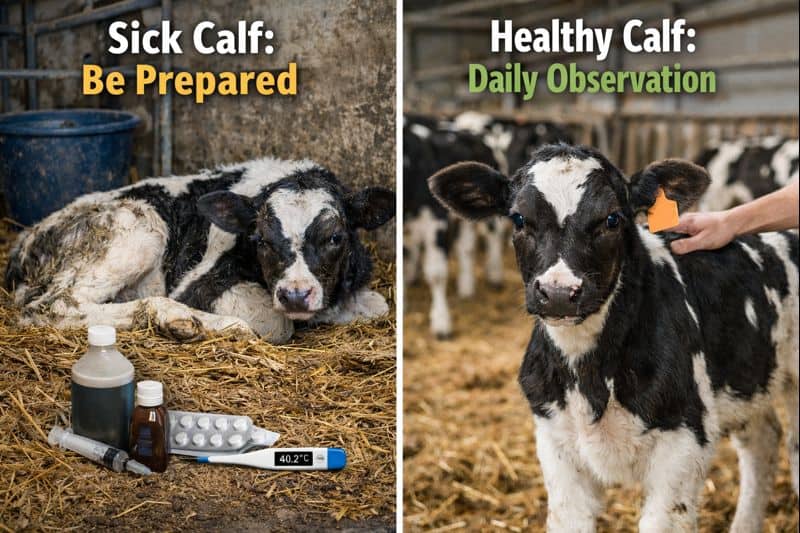
When I walk into a calf shed, I look at the calves first. Are they lying comfortably? Are they alert? Is their hair coat standing up? Are they huddled? Is there coughing? Calves will always tell you if the environment is right.
Cold is one of the biggest challenges. Cold calves burn energy just to maintain body temperature. That energy comes at the expense of growth and immune function — which is why cold calves so often become sick calves.
This is why higher milk intakes help, and why bedding matters so much. Deep, dry straw provides insulation and allows calves to nest. Straw remains one of the most effective tools we have.
Calf jackets can help in certain situations, particularly for younger calves, but they’re not a substitute for good bedding and nutrition. Supplemental heat sources may become more common in future, but simplicity usually works best: enough milk, enough straw, jackets where appropriate.
Air quality is the other major piece. Calves need fresh air, not draughts. Draughts are high-speed air movements that strip heat away. Fresh air is slow, continuous air exchange that removes moisture and pathogens without chilling calves.
Humidity increases heat loss through evaporative cooling. In damp conditions, calves lose heat more quickly through conduction, convection and evaporation. Dry bedding and good drainage matter.
Positive pressure ventilation systems can work very well when designed properly. Tubes must deliver air gently at calf level. Poor setup creates draughts rather than fresh air. Variable-speed systems and thermostats help.
If pneumonia is a recurring issue, ventilation and stocking density need review. Pneumonia vaccination can really help calves, but without addressing the environment at the same time, results are often disappointing.
Space matters too, and while it deserves its own discussion, overcrowding increases stress and infection pressure. Disease spreads faster when space is tight.
Drainage is often underestimated. Moisture build-up creates ideal conditions for disease. Small adaptations to existing sheds — improving airflow, reducing stocking pressure, using spare housing — can make a big difference.
Separating bull calves from heifers can help manage pressure, but every calf still deserves the same standard of care. Poorly managed groups increase disease risk across the system.
Finally, systems must work for people. If sheds are awkward to work in, routines break down. Simple, repeatable systems are far more likely to be delivered consistently.
Pillar 6 – Space, water and comfort: the quiet drivers of performance
Space per calf warrants its own section. It’s one of the fundamentals that quietly determines success.
A healthy calf should double its birth weight by weaning. Space allowances need to reflect that growth. From what I see on farms with lower disease levels, around two square metres per calf works far better than the legal minimum of 1.5 square metres, which in my view is too low for modern systems.
Space costs money, and concrete isn’t cheap. But overcrowding is a recurring feature on farms struggling with disease.
Space isn’t just about floor area. Layout matters. Systems with concrete feed fronts and deep straw lie-back areas allow calves to rest properly and stay warm.
When animals are confined, airspace is reduced, humidity rises, contact increases, and pathogens travel more easily. Infection pressure climbs quietly.
Isolation pens have a role, particularly for very sick calves needing heat and fluids. But in seasonal systems, disease often spreads before a calf is removed. Group management, age separation and reducing contact points often deliver bigger wins.
Comfort also includes pain management. Procedures like disbudding are significant stress events. Local anaesthetic and anti-inflammatories make good biological sense, and stacking stressors should be avoided where possible.
Water is another underestimated factor. Calves need access to clean water from a young age. Water supports rumen development, microbial activity and overall performance.
Header tanks and drinkers are often forgotten. Stagnant water and biofilm build-up are common. Checking and cleaning water tanks is worthwhile, especially where water feeds into automatic feeders or milk mixing systems.
Water quality testing is simple and revealing. Poor water doesn’t always cause obvious disease, but it quietly undermines performance.
Space, comfort and water rarely shout for attention — but they strongly influence how calves cope. When these basics are right, calves settle, grow and perform better.
Pillar 7 – Gut health, resilience and the microbiome: helping calves cope
If we step back and look at everything we’ve discussed so far — nutrition, colostrum, feeding, hygiene, environment, space, water, comfort — a common theme emerges. We’re trying to build resilient calves.
Not calves that never face a challenge, but calves that can cope when challenges arrive.
Resilience is about how well a calf absorbs nutrients, how it responds to stress, and how effectively its immune system functions when it meets infection pressure. At the centre of all of that sits the gut.
A large proportion of the immune system is associated with the gut. It’s where digestion begins, where immune cells are trained, and where the calf interacts most directly with the outside world. In early life, the gut is developing rapidly, and what happens during this window has lasting effects.
I’ll be honest — I’m biased here because I’m involved with Precision Microbes. But I also started as a sceptic. That scepticism is probably healthy. Any time there’s a strong professional opinion attached to a product, human instinct tells us to question it.
I like farming. I like veterinary medicine. I like science. And I’ve sat in enough rooms listening to discussions on antibiotic resistance and antibiotic reduction to know that we need better biological tools in this space.
What I’ve seen with Precision Microbes on farms up and down the country has genuinely shifted my thinking. On some farms the improvement has been gradual. On others it’s been dramatic. For me, it has been a game-changer — not because it replaces good management, but because it supports the system.
Gut health matters because digestion starts in the gut. We talked earlier about colostrum and nutrition. The beneficial microbes in the young calf’s gut influence digestion, barrier function and immune signalling. Around 70% of the immune system is associated with the gut. In seasonal calving systems, with high levels of pressure, how that gut develops early on is absolutely critical.
Precision Microbes is a very unique product. It’s a live, naturally fermented liquid, fed at 30 ml per calf per day from birth. It can be included in colostrum or the first milk feed and continued daily. It’s highly palatable and designed to support gut health during the most vulnerable period of the calf’s life.
Like any disruptive idea, there will always be people who try to copy it or piggyback on the concept. If something better comes along, I’ll be the first to congratulate that company — because it would be truly significant. But for now, Precision Microbes stands apart in how it’s formulated and how it performs on farm.
The research is there. I’ll link separately to May Allen’s trial, which was our first published study, we’ve also completed many more trials which can be viewed on www.calfhealthchampions.ie — including independent work by students and research institutes — all pointing in the same direction.
Precision Microbes doesn’t change calf health on its own. But when it’s applied properly as part of a wider system, it supports digestion, stabilises the gut, and helps calves cope better with pressure. That’s been my consistent observation.
It fits naturally into the seesaw framework — supporting immunity without increasing infection pressure.
Pillar 8 – Weaning and rumen development: protecting early gains
We’ve focused heavily on early life performance, and rightly so. The first few weeks of life shape everything that follows. But to complete the picture, we have to talk about weaning.
In natural systems, calves wean slowly over many months. In dairy systems, we shorten that process dramatically. What we’re trying to do during weaning is develop a fully functional rumen so that the calf can transition successfully into the next stage of its life.
We’ve made massive improvements in the first six weeks of life. Credit where it’s due — farmers, vets, advisors and everyone involved in calf health have driven real progress. Where I now see more challenge is around weaning and the period immediately after it early grazing.
Rumen development depends on several factors:
- early access to concentrate,
- sufficient energy and protein,
- starch to drive rumen papillae development but not too much!
- fibre for rumen function,
- and time.
One of the big challenges in group-fed systems is variability. Some calves may be eating four kilos of concentrate, while others are barely touching 100 grams. That variability matters.
Personally, I like to see calves averaging closer to two kilos per day of a good-quality ration before full weaning. The calves will tell you when they’re ready. Are they settled? Are they ruminating? What does the dung look like?
Weaning doesn’t eliminate problems like summer scour — that’s a more complex issue — but a well-developed rumen is a crucial piece of the jigsaw. Poor weaning makes calves far more vulnerable later on.
Slow and steady really does win the race
One significant trend I’ve seen more clearly over recent years is that slow and steady weaning consistently delivers better outcomes.
As discussed earlier, higher milk feeding often leads to a more extended weaning period. I don’t see this as a negative. From a rumen development and calf health point of view, it often works very well.
Whether calves are fed once or twice daily, and regardless of milk volume, the principle is the same: the rumen needs time to adapt. Weaning isn’t a switch — it’s a biological transition.
Calves should have access to concentrate from early life. Initially, they may only nibble, and that’s fine. Fresh feed daily matters more than intake early on. As milk reduces, concentrate intake should increase naturally.
A gradual step-down from peak milk feeding over two to three weeks allows calves to adapt without unnecessary stress. Rushed weaning often shows up as loose dung, poor rumination, loss of thrive and increased disease.
Every farm is different, but the principle holds: give calves time. Protect the progress you’ve worked so hard to achieve.
From pillars to progress: a final word
This has been a long read — and I know that. I love thinking about calves, watching calves, and writing about calf health. Writing helps me reflect on what I see on farms and spot the trends that matter.
Ahead of spring, knowing why you do what you do on your own farm is important. Time matters. Systems matter. And doing a good job for your system — not someone else’s — is what really counts.
I also want to say this clearly: I have huge admiration for anyone rearing calves. It’s one of the toughest jobs on the farm. It’s physical, relentless, and often happens at the busiest time of the year. Many changes cost money, but small improvements, applied consistently, can have a big impact.
That’s where the 1% rule comes in. Progress over perfection. Small changes over time.
If you have any questions about Precision Microbes, feel free to reach out to us at info@precisionmicrobes.com. We genuinely value the support we receive from farmers, and from what I see on farms, this product has been a real game-changer when used properly as part of a system.
If you’d like to go deeper on any of the topics covered here, there are more detailed dives available on the Tommy the Vet YouTube channel.
Keep up the great work.
Progress over perfection.
Simple done well.
Systems that support calves — and the people looking after them.
That’s what healthy calves are built on.
Tommy Heffernan Veterinary consultant
Info@tommythevet.ie